We just returned from our 10 day expedition to collect coral samples from Islas Wolf and Darwin. The journey to these northern islands is ~24 hours there, and as much as 40 hours back on our vessel the “Queen Mabel.” Long stretches of nothing but blue on the horizon emphasize the vast expanse of ocean and the extremely remote nature of this field expedition.
The Queen Mabel anchored at our destination. Photo credit: Stephan Hlohowskyj
This remote, the rules of field work are particularly critical. “Adventure” after “adventure” was continually thrown at us, and we continued moving forward (albeit sometimes very slowly), and with no whining. Even when it was, in fact, justified. Because unfortunately, one of Darwin’s many angry moray eels decided to break our amended rule #5 (no maiming, no death). And poor Gloria is left with a very bad wound on her thumb and is undergoing hyperbaric chamber treatment in town over the next few days.
But I’ll let her tell that story. Over the next few days, as Stephan and I get back on a boat, this time heading to Genovesa and Bainbridge for lake work, I will post a series of blogs recounting our adventures at Darwin and Wolf.
---------------------------------
But first if you’ve gotten past the jealousy, you might be wondering why on earth I keep going back to the Galapagos for work. What exactly is it that we’re doing here? And why so many trips, and can I take you with me next time?
The Galapagos are a hotspot for year-to-year changes in climate. Normally within the tropical Pacific Ocean, strong trade winds blowing from the east drive strong upwelling in the eastern Pacific, bringing cold, nutrient rich water to the surface around the Galapagos Islands. We can thank these nutrient rich waters for one of the world’s most productive fisheries.
But every few years, these trade winds weaken, and less deep water is brought to the surface in the eastern Pacific and local fisheries crash. Because this phenomenon happens around Christmas time, locals dubbed it “El Nino” (the boy). The Galapagos is located pretty much smack dab in the center of most El Nino events.
These El Nino events not only drive warm, nutrient depleted conditions in the eastern Pacific Ocean around the Galapagos, but they also change climate patterns globally. For instance, much of California and the western US experiences extremely high rainfall and flooding during El Nino events. Other areas, like much of the Australian continent, experience severe droughts during El Ninos.
Because of their global influence on climate, it is critical that we understand how the strength and frequency of these events may change in the future as the world warms. Unfortunately, we have very limited historical ocean observations in the vast tropical Pacific, and climate models disagree regarding changes in El Nino into the future. So we still do not have a very good understanding of how this extremely important climate phenomenon may change in the future.
That’s where we (my colleagues and I) come in. As paleoclimatologists, we study past climate changes to improve our understanding of the range of potential climate scenarios we may see into the future. To do this, we use natural archives of climate as windows into the past. For example, the rings of trees may tell a story of past changes in rainfall at a particular site, while bubbles trapped in ice sheets show how the composition of our atmosphere has changed through time.
To study past changes in El Nino, we capitalize on two of Galapagos treasures: it’s coral reefs, and it’s crater lakes.
Corals, like trees, grow in annual layers. Much like the rings of trees tell a story of past rainfall changes, the chemistry of layers of the coral’s skeleton paint a picture of past ocean conditions. Their skeletons tell us about the temperature, salinity, upwelling strength and even wind at the time the coral grew. From this, we can learn about the strength and frequency of El Nino events that happened before historical records were made.
Drilling a coral sample from Wolf Island in 2010
But unfortunately for us (and the coral, of course), most corals only live to be a couple hundred years old. So even the largest, oldest corals we take samples show us a glimpse into the past few hundred years. Corals that long since died, either submerged or tossed up onto the beach, can give us windows into the distant past, but many such corals are needed to try to piece together the history of climate changes.
But that’s where the Galapagos crater lakes come in: volcanic craters that are filled with very very saline water (2-3 x the salinity of the ocean!). Sediments accumulating at the bottom of these lakes also tell a story of past El Nino, this time through their impact on local rainfall. During El Nino events, the Galapagos experiences heavy rainfall, which washes in material from the crater walls and changes the chemistry of the lake. These changes are recorded in the sediments accumulating at the bottom of the lake.
Sarah Truebe and I at Genovesa Crater Lake
Together, these corals and lake sediments tell us a story about the history of El Ninos. From this story, we gain a better understanding of how the strength and frequency of these important events has changed as the Earth’s climate has changed in the past (as a result of changes in input from the sun and the number of volcanic eruptions, for example).
The primary goals of this trip are twofold:
1) Collect additional coral samples from the northern islands
2) Maintenance and redeploy instruments recording the local climate at our lake sites
I’ll update the blog with our successes, and of course “adventures” along the way.
In prepping for this year’s Galapagos trip, Stephan passed along the 3 rules of field work he learned in field camp:
1) Adventure (not necessarily synonymous with fun)
2) No whining
3) Always moving forward
This will be my 4th field expedition to to the Galapagos, a place where field work is always full of adventure (for better or worse), making rules 2 and 3 critical. We therefore quickly adopted these rules as our mantra.
Even getting to the Galapagos with field gear always involves plenty of adventure, and this year was no exception. We arrived in the Galapagos successfully Sunday, with all of our gear in hand. But as in previous trips, this was no small feat.
The adventure hurdle came early via a luggage embargo by the Ecuadorian government: no more the 2 bags/person and 50 lbs in bags/boxes of precise dimensions. Underwater drill, air compressor, dive gear, lake gear and personal gear all in 8, 50 lb bags. After 12 overweight, oversized bags for 2 people in our first field expedition in 2009, this may be a blessing in disguise. Well, assuming we can somehow make it all fit. Armed with multiple scales, we set on a multi-day adventure of life-sized game of Tetris.
One thing was clear from the get-go. Our shiny new tripod to replace the rusted weather station on Bainbridge was not going to fly. Pun intended. After Gloria was sent on numerous goose chases, calling the airline, the Quito airport, airline, airport, airline (…you get the picture), we were left with one option: cut the tripod and piece it back together when we arrive.
A new, miniaturized weather station later, we were able to fit all of the pieces in the bags….just barely.
Cleaning and prepping old and sometimes dysfunctional field gear, we also added a new rule to the rule book:
4) No schmutz
Which is, of course, the technical term for the mud and gunk caked on old field gear, which causes much dysfunction and frustration to users down the line. So just say NO to schmutz.
But most importantly, in discussing the difficult and tenuous journey to Genovesa lake that evening over beers, we decided on one last, critical rule:
5) No maiming. No death
Last, but not least.
--------------
Saturday morning our gear was whisked off at the Tucson airport, within error of our 50 lb limits. And checked straight through to the Galapagos?!?! You mean no more luggage handling at midnight at the Quito airport? No schlepping heavy field gear to the hotel only to get up only a few hours later to bring them right back for the early A.M. flight out? A new and amazing luxury!!!
Except when things are too good to be true, they probably are. Again, this was no exception. A moment of disappointment passed when we saw our bags appear on the carousel in Quito. But hey, they all arrived, and for that we are always thankful.
We heaved the gear onto carts and offloaded them onto the first of many x-ray machines. And the large metal poles and drilling equipment launched the first of many explanations of our scientific purpose in the country and proof of permits. Exhausted, after a long day of flying and whirlwind of luggage and Espanol we crashed for a short night of sleep.
In the morning, it all began again. Luggage from hostel to truck; truck to Ingala x-ray; x-ray to check in. Excess baggage fees. And finally, back to Ingala for the most important step: our passes to enter the country as scientists. Not tourists, but scientists. This is critical. Because without it we cannot do our work, and would have to return to the mainland and enter with the proper card. Catch is: the paperwork we need for this has been completed by the park, but not yet given to us. They can see our permission in the computer, but insist on us presenting a paper copy. Our flight now less then an hour from take-off, we frantically try to contact the officials to see what we can do.
No luck. Nada. Defeated, we returned to Ingala, only to discover that they had apparently made an executive decision that it’s suddenly fine. A change of heart? An acceptance of the reality that we have our necessary documentos? No se. But, we had permission. We rushed off to the plane, now minutes away from boarding.
When we landed in Baltra, we began the “planes, trains, and automobiles” part of the adventure to get to the Darwin station. But replace trains with ferries, since this is the Galapagos, after all. In bursts of chaos, we transferred our stack of luggage from carousel to bus, bus to ferry, ferry to taxi.
Around 2 pm we arrived exhausted, famished, and dehydrated to the Darwin Station, having now missed both breakfast and lunch and lacking enough purified water. We were all thankful for Julie’s Trader Joe’s sesame almonds that had kept us going, but we really needed a real meal.
But when we arrived at the station, we encountered our last adventure of the day: the security guard (who is supposed to give us the key to our rooms) was nowhere to be found. The entire station was deserted, save (of course) the usual waves of tourists coming to see the exhibits. We offloaded our gear at the dorms and wait in the heat.
Turns out our reservation was lost. Never made. We have no rooms for the trip. Thankful that they’re able to squeeze us in for one night, we finally are able to settle in.
And after a long day of adventure, nothing tastes better than William’s pescado enconcado!!
Or alternatively, the story of the tortoise and the hare, mountain style. But I'm getting ahead of myself again.
Map of Cotopaxi National Park and the two volcanoes I climbed
On Sunday, I arrived back to Quito around noon, and had a relaxing afternoon around my hostel preparing for my trip to Cotopaxi. As I packed, I started getting more and more nervous. What was I getting myself into?!? After over a year of dreaming of the summit, I started to worry that I wasn't going to make it...
A number of people at the school in Cuenca were sick, and I had felt like I had been fighting it off all week. I had grand plans to run everyday along the creek to keep in shape for the climb, but instead I had slept in every morning, hoping I would at least not get sick. Returning to Quito at an elevation of a little over 9000 feet, I felt tired even climbing to the reception on the 5th floor of my hostel. Yikes.
Feeling exhausted, I decided all I could do was get a good nights sleep and hope for the best. After expressing my concern to Jeremy over skype, he helped me remember the big picture. No matter what happens, it'll will still be an incredible experience!
So I headed to bed early, hoping for a solid 10 hours of sleep. But between the excitement, anticipation and nerves, I hardly slept a wink. And when I did sleep, I had disturbing dreams. Very disturbing. At one point I was dreaming that I was killing a cat. I'll spare you the details, but it was gruesome. Likely a side affect of Diamox, the altitude sickness med I was taking as a precaution. That and the weird tingling sensations in my hands and feet...
So now really exhausted, I was picked up by my guide's father on Monday morning. He immediately started saying something about my boots. My guide had told me he'd have 2 sizes of plastic climbing boots for me to try, so I wasn't sure why this was an issue. What was he saying? Does he not have them after all? I was too tired for Spanish and he was using words that I didn't understand. Although worried I was going to start the trip off on the wrong foot with no boots (literally- ha!), I was thankful we turned to everyday conversation that I could handle well.
Fortunately, when I met up with my guide, I realized he was trying to tell me that I should try them on to make sure one of them fits. Apparently they were in the trunk the entire time. Ahhhh! So although my Spanish had gotten to the point where I could have intelligible conversations, clearly there were still many things outside of my limited vocabulary. I was thankful then that my guide's English was far better than my Spanish. And it was better than you'd imagine from his emails, which required some interpretation and were often pretty funny. My favorite being, "please if you have a dude or question." ?? :)
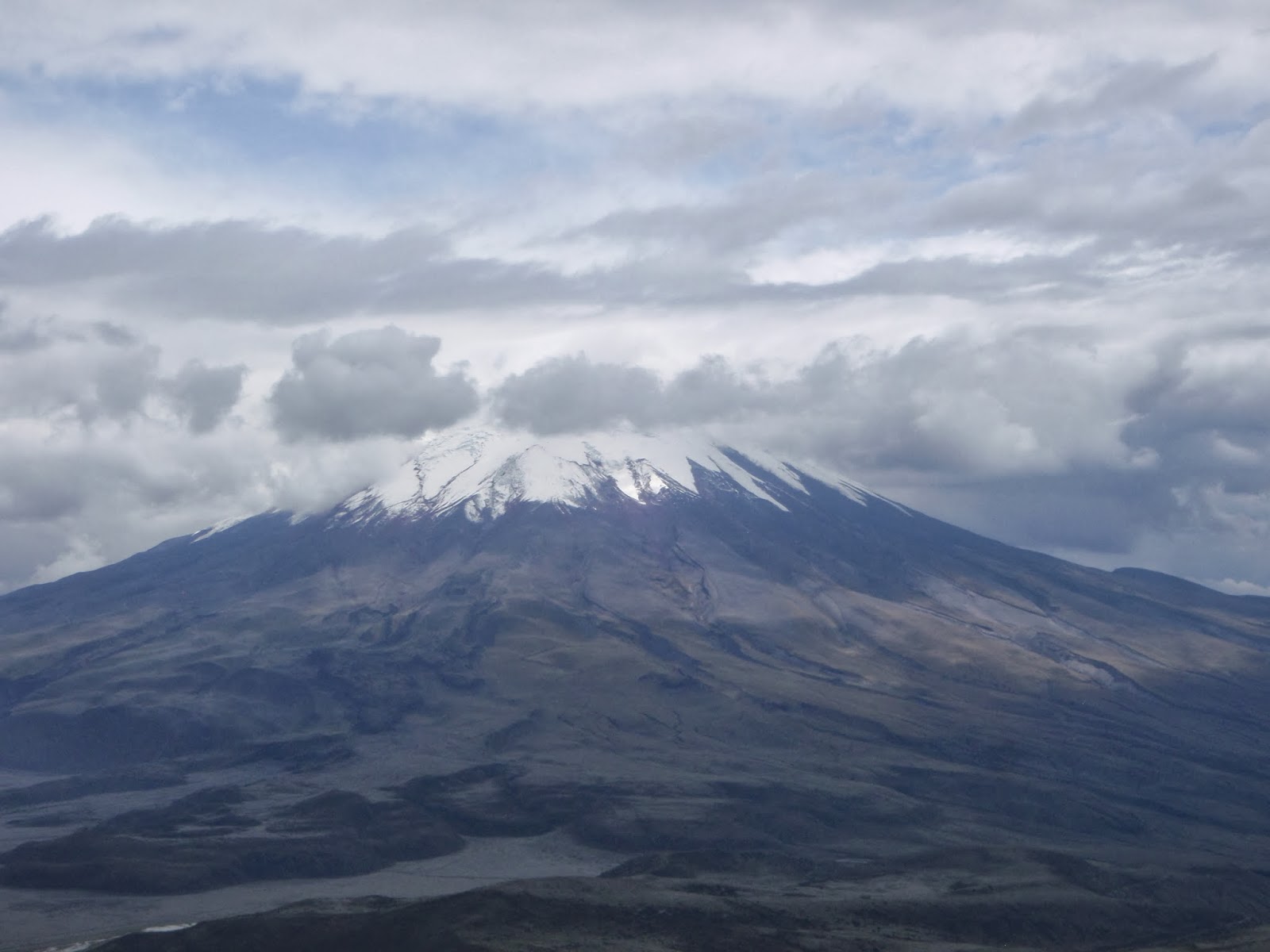
We headed to Volcan Rumiñawi, a dormant stratovolcano in Cotopaxi National Park that would serve as an altitude acclimation hike. It was a beautifully clear day, giving me gorgeous views of Cotopaxi for the first time on the trip:
We arrived at Laguna Limpiopungo, a lake between Cotopaxi and Rumiñawi and the starting point for our hike for the day. However, due to dry conditions there wasn't much left of the lake. My guide told me it has gotten smaller and smaller every time he visits. One of the many signs of climate change I would see on this trip. :/
As we hiked toward Rumiñawi, clouds started rolling in and the weather got progressively worse. I was bummed, because the views of Cotopaxi from Rumiñawi were supposed to be spectacular on a clear day. My guide just laughed and told me just wait, it might clear up again. He said that the guides here always say that the weather in the mountains is like a woman: it changes rapidly. Ha!
By the time we got to the top of the ridge for a lunch break, Cotopaxi had disappeared behind blankets of clouds and snow.
But sure enough, by the time we reached the top of Rumiñawi there was enough of a break in the clouds to get a glimpse of Cotopaxi:
I relaxed for a while, catching my breath and taking in Cotopaxi's captivating beauty. Despite feeling winded, my guide told me that we made excellent time, knocking over an hour off the usual time to the crater. That made me feel more encouraged about my physical condition, so I kept my hopes high as I sat dreaming of the summit...
Then my guide and I sat on the side of the crater and watched as the clouds hit the crater walls and swirled up and over us.
The route down the steep crater walls was super fun, and involved basically running down a scree slope of volcanic sand. It reminded me of the descent of SP crater near Flagstaff AZ, but with less rocks! And adult, fun-sized mix between a sandbox and a ski slope :)
We finished the hike just as the storm really set in, dumping cold rain all over the valley.
Meanwhile, Cotopaxi was getting pounded with snow, leaving about 12 inches of fresh snow for our climb...
All things considered, we had been really fortunate with the weather for our hike. My guide joked that I must have made an offering for the good weather. I was reminded of my horrific dream about the cat. Huh. Maybe I was making an offering in my dreams for good weather?!?!
We arrived wet and cold to our lodge, hoping the storm would pass and leave us with a clear day for the summit. I was thankful to have a warm fire and hornimans to keep me warm...
I went to bed early and slept hard, so hard that when I was woken in the morning to the sound of a herd of cows mooing outside of my window, I thought it was my guide calling me to wake up! ha.
Unfortunately, the clouds still lingered over the valley and hung low over Cotopaxi, completely blocking it from view.
By the time we arrived at the base, the snow had finally stopped, but clouds and fog still lingered.
But I was excited and ready for the big climb nonetheless!
We carried our gear from the parking lot at ~1500 feet to Refugio José Félix Ribas (@ ~15750 feet), our base camp for the climb.
After some much needed hot soup and an hour nap in our sleeping bags on the military style cots and bunkbeds of the refugia, we hiked up to the glacier to practice the technical skills needed for the climb. Soon after leaving the refuge, the guide pointed to the red rocks on the slopes and told me that the glacier used to end here:
Now, the glacier is almost an hour hike up the slopes from the refuge! Like other mountain glaciers, the Cotopaxi glacier is receding rapidly. :( Here is a picture of the start of the glacier up ahead:
At the glacier, he taught me the various techniques for using crampons and ice axe to ascend and descend the glacier, cross crevasses, and stop a fall. I had never used either before, but I felt like I picked it up pretty quickly and was comfortable by the end of our short lesson. Good thing...I'd be doing it all again in a few hours in the dark!
At the end of our lesson, he showed me a technique used for climbing very steep slopes, noting that this technique isn't necessary for Cotopaxi. Thanks to the heavy snowfall the night before, he would eat those words later, so I was very glad he showed me...
We went back to the refuge for hot drinks, trout dinner and laughs with the other climbers and guides. By that point I had become famous around the refuge as the "un mil novio chica." ha. Don't ask how that started, let's just say the guides to a liking to the tall blond haired climbing chick.
And without any other source of entertainment (or warmth), the guides showed off their incredible ability to do pull ups off the paper thin edge of the ceiling...
After bs-ing for probably far too long, we all headed to bed to try to get a least a few hours of sleep. They had broken the climbers into two shifts, one group that would wake up at 11pm and start climbing by midnight, and another that would get up at 11:30 and start by 12:30 am. My guide and I were in the second group.
I hardly slept, and at 11 I was woken to the sound of the first group getting ready to go. Their plastic boots on the wooden floors sounded like a heard of elephants! Even if I was sleeping, I certainly wasn't anymore! Might as well get up and start getting ready too...
When we hit the glacier, we donned our crampons and started the long, slow slog up the mountain. As I tried to get in the the rhythm, I listened to the sound of my guide in front of me and repeated his words from our practice the day before: piolet, crampon, crampon. Piolet, crampon, crampon. Piolet, crampon, crampon...
For hours. At one point, one of my favorite lines from the movie "A Knights Tale" popped in my head: "To trudge: the slow, weary, depressing yet determined walk of a man who
has nothing left in life except the impulse to simply soldier on," which made me laugh to myself. It certainly felt like a trudge, but of a very different sort. A fun, self-imposed trudge!
But I got into a groove, and suddenly we were at the first break spot, a glacial cirque that provided protection from the wind. My guide told me it was 3 am and that we were already at 17000 feet meters! I was feeling great and I was starting to feel optimistic about my chances for the summit. Although we couldn't see it in the dark, the cirque was beautiful!! Here is a picture of it on the way down in the daylight (unfortunately none of my videos from the descent turned out because my camera was completely iced over :/):
After this point, it started to get legitimately cold. At one point we passed another group, and I noticed that their eyelashes and facial hair were covered in icicles! I was starting to loose feeling in my fingers and face, and was regretting not having put on my heavier gloves and balaclava. By this point, my buff covering my face was wet from the inevitable sweat and runny nose. Awesome.
So I was thankful when we arrived at the second cirque at ~18400 feet around 4:15 am and could change to my heavier gear. However, despite only being there for a few minutes and having my gloves off only a bit, my fingers only got worse. Soon, the discomfort had turned to pain, and I was having trouble even holding my ice axe. I stopped the guide, and he sweetly rubbed my hands to warm them up and offered me his gloves. At first the pins and needles feeling was super painful, but I regained feeling to my fingers. By that point the guide was asking me to call him "mi amor," but I was thankful of his sweet endearment...
At that point, we had less than a thousand feet to go, but he said the last part was steep. And little did we know, it was going to be even more steep than usual thanks to the snow. We caught up to the groups of guys who started at midnight and had took off for the races. They were barely moving, and their guide was barking back at them "recuerda!" It had become very steep, and required a different technique, and they were struggling with it and falling backwards.
My guide and I slipped passed them, and continued on slowly up the now quite vertical slopes using the pick of our ice axe and tips of our crampons:
So despite being one of the last groups to start, we paved the way to the summit through the fresh snow. Girl power; tortoise power! ;)
As we crossed the dome of the summit, I was so excited that I could hardly catch my breath and I had tears in my eyes. After a congratulatory hug from my guide, I explored the summit before everyone else arrived. I felt like I was on top of the world!
When the next group arrived, the guy just crashed to the ground, exhausted. We had a good laugh about how I was the only one still with energy. I thought to myself, slow and steady! When the rest reached the summit, we all cheered and celebrated our successful summit. We made it! :)
Here is a video compilation from the summit (sorry for the haze, it had become covered in ice!):
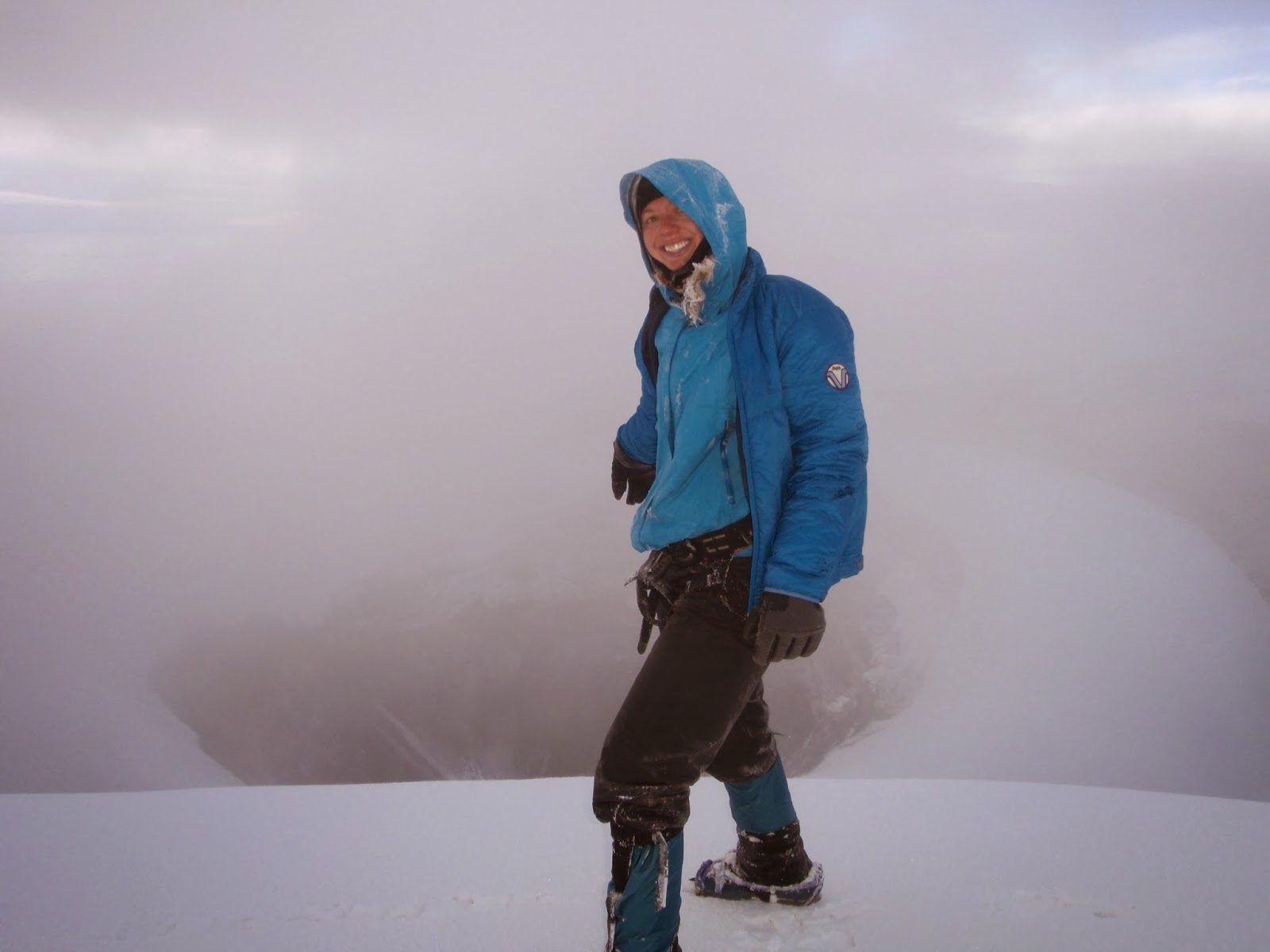
Here I am at the summit, with views of the crater below (and icicles in my hair!)
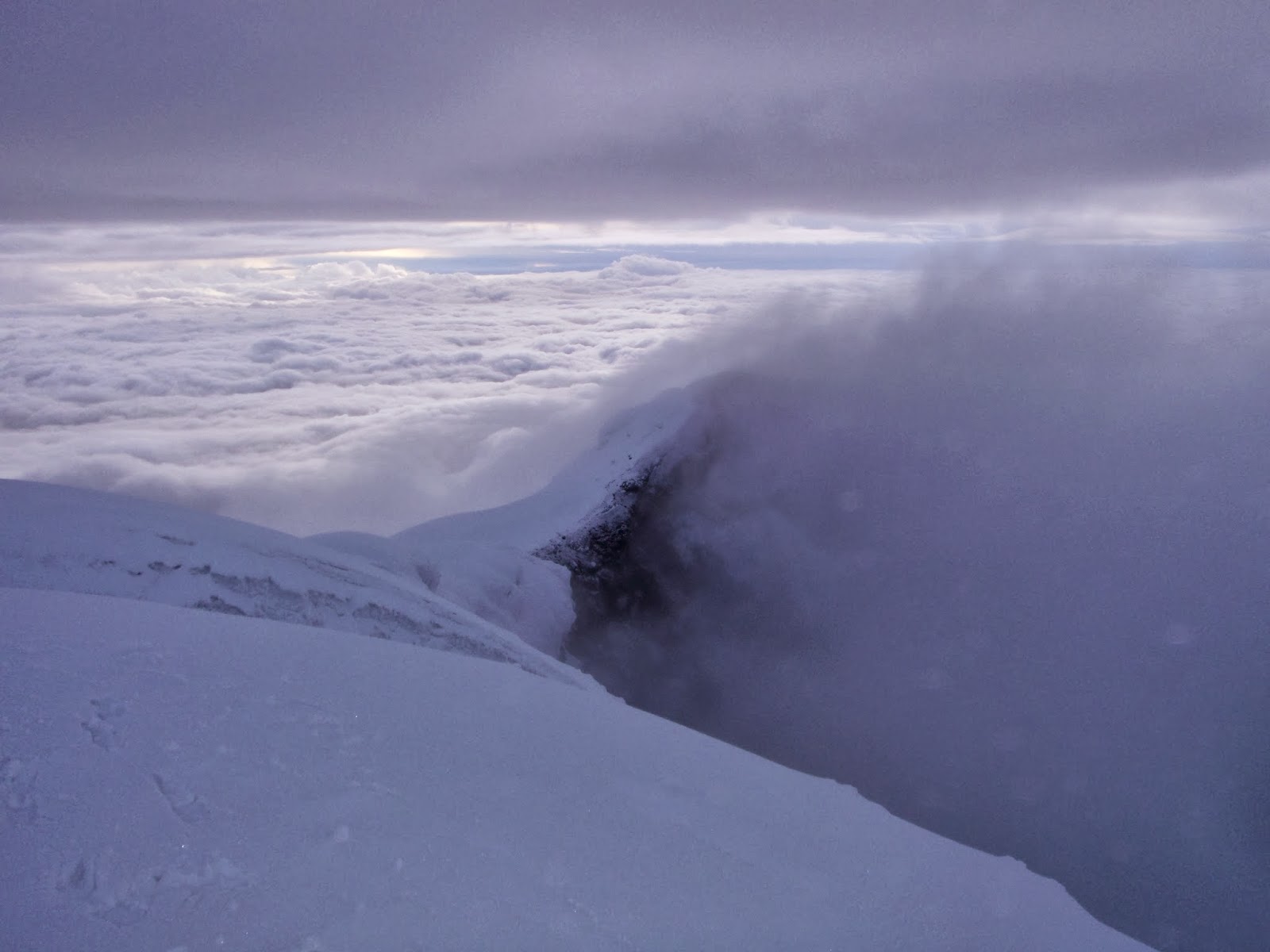
On top of the world!!! (Ok, well most of the clouds at least!)
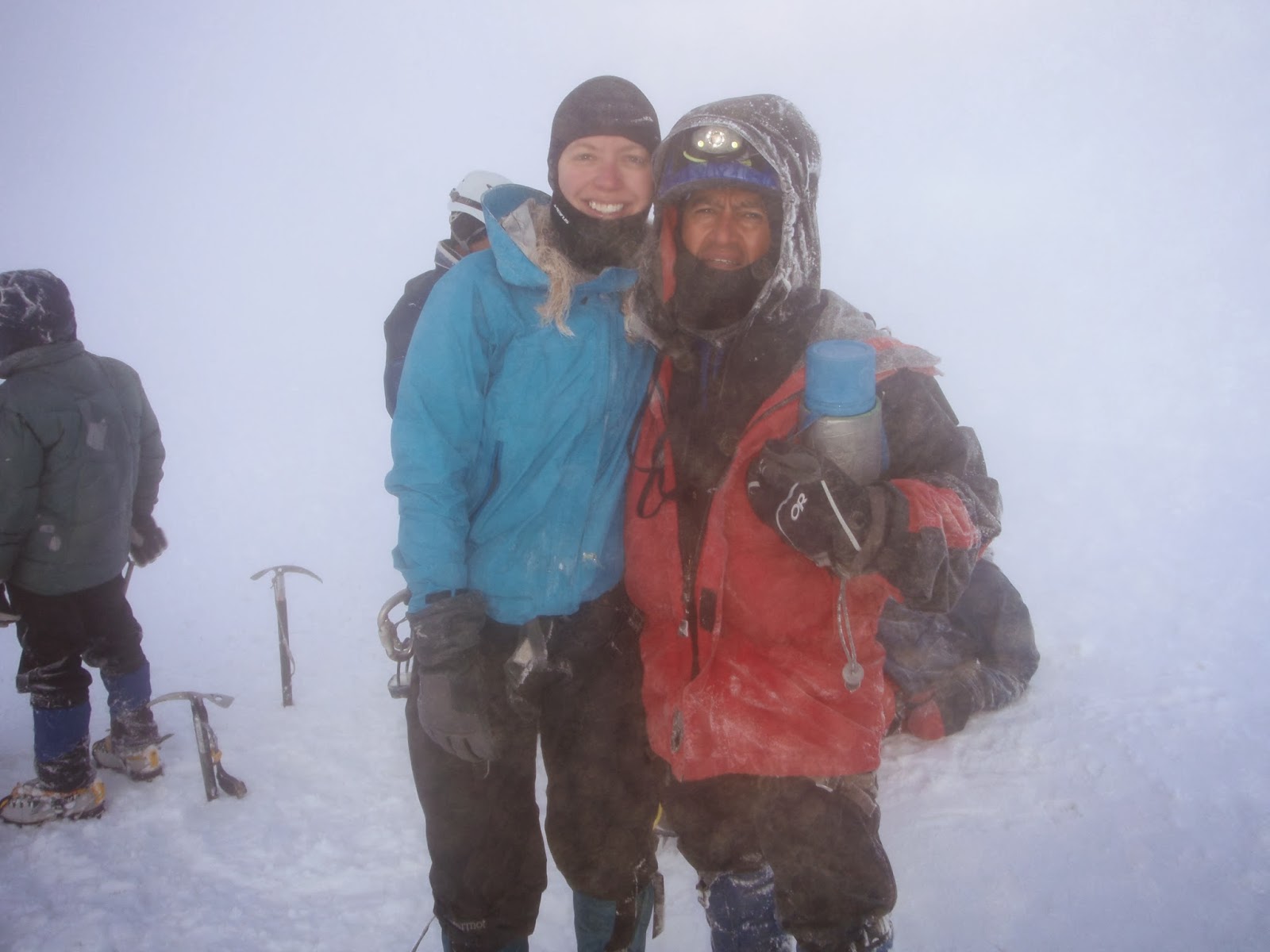
The summit gang!
My guide, Edgar, and I. If any of you ever want to climb Ecuadorian peaks, I recommend him highly!! (http://www.edgarguide63.webs.com/)