Wednesday, July 27, 2016

Iakwe/Yokwe: "You are a rainbow"

This is the way you say "Hello", "Love" or "Goodbye" in Marshallese.  But directly translated, "Iakwe" (or "Yokwe") means "You are a rainbow".

And this deeper meaning says so much about their culture.  

Rainbow over Arno lagoon
After only a few days of being on the islands, you can quickly see how the rainbow has become a cornerstone of their language.  Frequent tropical rain showers give way to beautiful rainbows over the turquoise waters.

Although somehow I captured so few pictures of these beautiful rainbows, their beauty remains clear in my memory.   

But that's not what has really stuck with me from this trip.   It's the people and their incredible generosity.

I want to say "Kommol tata" ("thank you very much") to Tamara, Karl, Cary, Rodney, Tanta, Kalena, Flo, Emma (and the other MIMRA folks!) for making our work possible.  An especially big thanks to Tamara, who was instrumental in helping us make local connections and arrangements!  

Can't wait to work with you all more next year!!


Monday, July 4, 2016

"Majuro Corals" off "Mount Majuro"

Mount Majuro.  The highest point on Majaro Atoll.  

The garbage dump.


Today we went surveying off of the south side of Majuro, near the airport and the garbage dump, and found (drum roll please): lots of garbage! 


Slipper lobster?  NOPE.  That's a used diaper waving in the surge.  Gross.

The scientists at the Marshall Islands Marine Resources Authority call the pieces of trash "Majuro Corals."  There were some incredibly huge Acropora tables holding on, but much of the reef consisted of dead coral framework.  


We talked to the expert "garbologist" (as he called it), Alice Leney, who helped Tarawa Atoll with their garbage control by creating a bottle and can recycling program with monetary incentives called "Kaoki Mange" ("Return the Rubbish").  

He said not only are there not any incentives like that here, but infrastructure and space are an issue. The US sent American-sized garbage trucks to Majuro, which are completely impractical for the much smaller-scale operation needed on the island.   

People are working hard on this issue here on the island to try to solve these problems.

In the mean time,  rubbish ends up on the top of mount Majuro.  A mountain with bounds.  After mount Majuro can climb no more, they've proposed to dredge up more reef to create more "land" for another land fill.

Most places in the world, we can go about our daily lives blissfully unaffected by the magnitude of trash we produce as a society.  We throw our rubbish in the garbage, a trash man comes and picks it up, and that's the last we ever see of it.  

But Mount Majuro isn't unique.  We're just fortunate to have a place to put it.  For now. 

But the impacts of our rubbish are here and now.


Inspired by the movie "American Beauty"


Saturday, July 2, 2016

Fossil hunt/biking adventure on Arno atoll

Please pinch me...

I must have died and gone to heaven.  In Arno.


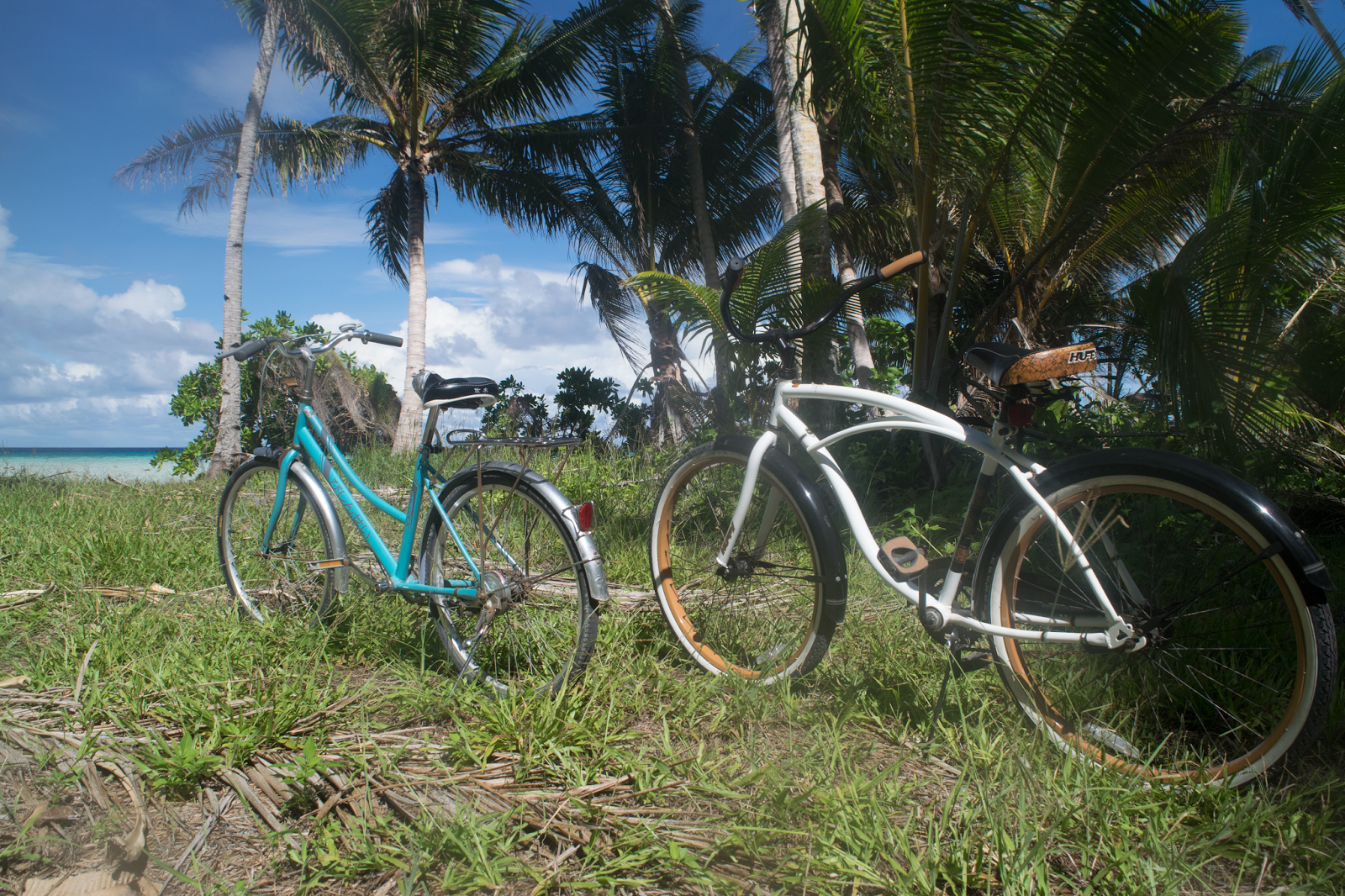
On Monday and Tuesday I "toodled" around Arno Arno on a fixie beach cruiser with my local guide Tonta is search of fossil corals. Besides a brief moment when I was chased by a scary looking dog, it was one of my favorite bike rides (and for that matter days) of all time.  Riding over palm fronds along a faint car track, it was basically mountain biking "island style".

Tonta and I rode side-by-side in the two single track bike trails created by the few trucks on the island over the years. Every so often, we would have to dismount our bike or ride slowly through/ under a softball or volleyball match between the local boys and girls.


Then suddenly the thick canopy of palms opened up to a sight of the turquiose lagoon as we rode to the end of Arno Arno, where we spent much of the day in search of coral.   I baked under the tropical sun in the guam dress that I wore out of respect for the local culture, but I loved every second of being in this enchanting place.  Plus, I've never looked so nice while sweating my buns off working in the field ;)

I arrived back to our house just as a tropical rainshower started pouring on me. It was admittedly quite refreshing given that I was covered from head to toe in glistening sweat.

Arrived back to our hut completely stoked and soaked :)

As I dashed under the tin roof, my colleagues handed me a fresh coconut.  An extremely refreshing treat after a long, hot day; the perfect end to a perfect day.

                             ____________________________________________________

On Tuesday we biked towards the other end of the island along a thin strip of the atoll-- the turquise lagoon on our one side and ocean on the other-- looking for fossils.


But the highlight was definitely when Tanta and I rode down the lagoon beach to avoid the angry dog.  It was quite a work out and absolutely gorgeous.


Meanwhile.....my colleagues Simon, Sara and Emma had an exciting day surveying the reef (to say the least!).  They caught a ~120 lb yellowfin Tuna, which Emma ended up helping reel into the boat!  While they were all laboring as a team to bring in their catch, a pilot whale was breaching nearby.  You can read more about their crazy adventures on Sara's blog.


I was bummed to have missed what was quoted as "the most insane 10 minutes of their lives", but my time spent on land was incredibly rewarding in itself.  In some strange way, I was thankful for my surgery, because it gave me the chance to take advantage of the opportunities on land that I otherwise wouldn't have had.

Life is good.  And science is awesome.

I'll have to save the details for another day...


Saturday, June 25, 2016

"Iokwe aolep jān Majuro"

"Hello (love) everyone from Majuro".

First view of Majuro out the plane window
We arrived safely in the Marshall Islands today after a great week in Hawaii at the International Coral Reef Symposium.  As the wheels hit the one lane tarmac, closely straddled by the lagoon on one side and the ocean on the other, I breathed a sigh of relief.  Not only was it a bit "exciting" to land on such a narrow piece of land all but being engulfed by the water due to extensive dredging, but I was also so thankful to have arrived despite all odds.


We've been planning this project/trip for the last 3 years or so, and it hasn't been an easy road.  But we fought through all of the hurdles that came our way, and we were finally making it happen. 

Until my appendix decided that it wanted out.   A week and a half before our departure date, and less than a week before my trip to Hawaii, I found myself in an emergency appendectomy.

Maybe we were trying to force the shoe to fit?  Or I had pissed off some field work gods?

One organ less and three incisions later, I found myself on the road to recovery.  The seemingly slow road to recovery.  2 weeks has never felt so long.
It may be laproscopic surgery, but these incisions were still quite sore and swollen!


Tomorrow we head to Arno, which is an outer island about 1.5 hours away by boat.  We'll spend the next four days surveying the reef there.  But this time, I'll have to watch from the boat.  Scuba diving definitely doesn't fall into the category of not lifting more than 10 lbs or not soaking in standing water.  Sigh.


Hopefully I'll be healed enough to dive by the end of the trip.  Continued healing thoughts, please!

But in the mean time, it's a great learning experience for my new graduate student Emma Reed, who I know will do a great job surveying alongside my extremely experienced colleague.


I'll write more when we return (must catch some zzzzs!).  But in the mean time, enjoy some pictures from our flight in!


View outside our hotel


Thursday, May 12, 2016

If it’s too good to be true…


maybe, for once, it isn’t?!?

_________________________________________________________________________________

Over the past 5 trips to the Galapagos, I’ve come to accept the reality that it is inevitable that something will go wrong (and more likely many things).   Like with weddings, all you can do is hope the problem is not a show stopper.

For instance on our first trip, they refused to let us on the plane with all of our field gear and we had to send it via a cargo plane from Quito, delaying our trip by a week and causing us to start the planning and paperwork from scratch (and cancel our return flights home for an unknown future date, not knowing when our gear would actually arrive).  Fortunately, our bags eventually arrived and we carried on with our “plan B”.   I navigated the language barrier through the pile of paperwork, logistics and quarantine completely naïve to the many subtleties of the process (signatures, stamps, formalities). In retrospect, it is nothing short of a miracle that it all got done.  The wonderful people at the Charles Darwin Research Station were entirely to thank for that.

Our gear in quarantine

Then there was the second trip, when I naively thought that things would go smoothly since I knew the process. HAH.  After the luggage snafu of the first trip (and since we would be drilling coral cores using a hydraulic drill) we sent all of our gear from the states…6 months in advance!! That should be plenty of time, we thought.  Wrong again.  We arrived in the Galapagos without our gear, and once again had to play the waiting game…

And then there was the trip where we didn’t get our permit or transuéntes (which allow us to enter the Galapagos as scientists) in time for our trip.  So we had to leave our passports at the airport…

And that other time when the director of the Galapagos National Park threatened to take away our permit (due to a mistake with the paperwork)…

You get the point—it’s always something.  And usually a show stopper.  Someone here summed it up well recently: “They think that by making things more difficult, they’re being efficient.”

It always felt like you were cruising along jumping the known hurdles, only to find out that they had moved 6 inches from last year, and you trip and fall on your face.

_________________________________________________________________________________

But not this time!  Maybe the 6th time is the charm, but this trip has gone shockingly smoothly.

The trip started out on the wrong foot, when (as per usual) they called us to the back of the airport within minutes of our flight’s departure to check the bags containing our equipment.  The extra large duffels full of electronics, metal rods, and other assorted equipment always draw their attention.  It isn’t clear to me why they ALWAYS wait until the last minute to check, but it never fails.  Once again, we find ourselves sprinting back to the gate behind the gate agent, arriving 5 minutes before our departure…

But our bags were not as fortunate.

Our pile 'O gear


As our bags were being inspected, they had filled the rest of the luggage space with cargo for the islands—including someone’s new, widescreen TV.  By the time our bags arrived, there was no more space, and our bags were left behind.

Then, and only then, they decided our bags were dangerous (after the opportunity to look again).  Fortunately, after a bit of negotiating by our Ecuadorian student volunteer, I signed off on an agreement that there was nothing dangerous in our bags and we were told they’d be on tomorrow’s flight.

A day delay? That’s nothing in this game.  As long as they come tomorrow, as they had nearly all of our gear!  We wouldn’t get very far without them!

The next day we finished our paperwork, met with the director of the GNP (who ALWAYS finds some sort of problem), and did quarantine-- and it all went swimmingly.  There were NO issues.  And he even said I could do my talk in English (thank goodness!).  Those of you who know my fluency in Spanish know how painful that would’ve been for the audience…  I can get by in conversational Spanish, but I certainly can’t give a science talk!!!
Our gear being inspected before quarantine

_________________________________________________________________________________

May be I jinxed it, as I woke up this morning feeling the start of a bad cold.

Hopefully I'm not breaking our new rule of field work: (6) No Zika.


After our gear finishes in quarantine in this morning, we head to Genovesa and Bainbridge on the Pirata to collect our samples from the 2015-2016 El Nino event.  The locals have all given reports of a “weird” El Nino, in which there wasn’t as much rain as expected.  In March, they say that the water temperatures also rapidly cooled, suggesting that the upwelling has recommenced in the region.

I’m anxious to see what we’ll find…

(to be continued)


This material is based upon work supported by the National Science Foundation under Grant Number (NSF AGS-1561121). Any opinions, findings, and conclusions or recommendations expressed in this material are those of the author(s) and do not necessarily reflect the views of the National Science Foundation.

Wednesday, December 2, 2015

Observations of "the Niño": will it be another 82/83 sized event here in the Galapagos??

We are back in Puerto Ayora after an exceptionally difficult but successful trip to Genovesa and Bainbridge (more on that soon).  And now the fun paperwork Olympics has resumed, in which we run around between the Charles Darwin Research Station, town, and the Galapagos National Park offices over and over to get all of the important papers approved.  And stamped of course (they love their stamps!).

Our sample export perrmit, signed and stamped by the Galapagos National Park

Our samples, taped shut by the park and ready for export

But this trip it's a little different.  Usually the walk  is sweltering hot under powerful sun and high humidity.  This time, though, we are thankful for the higher cloud cover, and occasional light rains to keep it a *bit* cooler.  Much appreciated, though brief, relief from the heat.

And each time the dark clouds roll in, we point and joke, "THE NIÑO is comming!"  After the great Chris Farley skit, of course.

Jokes aside, we have found ourselves constantly observing slight differences in the way things are this year, and it's impossible not to wonder whether they are early signs of the El Niño.  

And we are not the only ones.  All around town, we hear chatter about the El Niño, and locals ask us what we think might happen this year on the islands.

So what have we observed?

The Bainbridge Flamingo population is down from January.  And there are grasshoppers everywhere (I just got attacked in the face by one!).

But most notably, ocean tempearture and pH have risen considerably. Both signs that the upwelling of cold, nutrient rich, low pH waters from below has been tempered by the El Niño.

And these warm waters have fueled storms, which soaked us at Genovesa, and made the sail between islands "exciting" to say the least.  Poor Frazer might not ever set foot on a sailboat again.  He was a bit green the entire trip....


Clouds building over Genovesa Crater Lake.  11-26-2015


But how does this event stack up to the other greats?  

We are fortunate to have one of the best sources of the local history at our fingertips: the captain of the Pirata, Lenin Cruz.  Lenin grew up in Floreana, and has lived in the Galapagos all of his life.  At 65 years old, he still sails scientists all around the archipelago on the Pirata.  He is quite a local legend.

The Pirata Photo by Stephan Hlohowskyj


While sailing to Bainbridge, Lenin told us how in 1982/83, he could see lightning hitting the islands on the horizon as he sailed.  He recalls that by mid-late December, it was raining hard all throughout the Galapagos. 

Waterfalls had formed over cliffs of dry, barren lava rock.  Lenin's front and back yards had become lakes. And the road between Baltra and Puerto Ayora had washed out in multiple places.  

To get around these obstacles, incoming tourists and locals were transported a few at a time in a construction loader!!  Transporting bus loads of people a few at a time, obviously took a lot of time. So local parties would go well into the night as they waited for all of their guests to arrive!  And I bet this was not exactly what the tourists thought they had signed up for....


When we returned, Lenin dug up an old letter from his mother in Floreana, dated December 12, 1982

Floreana, a 12 de Diciembre de 1982
Sr. Lenin E. Cruz 03
Puerto Ayora 
Mi hijito querido


In the letter, she describes the strong rains that they had been having, noting that the rains had come earlier than normal (although the wet season starts in December, most of the rain typically falls later in the season).  Prior to all of this rain, her well was very low from a long drought, so she also commented on this fragility.  Roughly translated, she said:  
"The rains are strong. I heard on the radio that they are strong on the other islands and all over the world.  The rains are ahead of schedule.  The rains are unpredictable, some years it rains, others nothing."

 So are these rains we've been having a sign of what is to come?   Only time will tell...


This material is based upon work supported by the National Science Foundation under Grant Number (NSF AGS-1561121). Any opinions, findings, and conclusions or recommendations expressed in this material are those of the author(s) and do not necessarily reflect the views of the National Science Foundation.

Tuesday, November 24, 2015

Sampling the 2015/2016 El Niño event

Tonight, we boarded the Pirata and sailed to Isla Genovesa, where we will begin our sampling expedition to capture the 2015/2016 El Niño event.  Hopefully, if you're reading this tomorrow morning, we are packing up our gear and beginning the arduous hike up to the island's crater and down its walls to Genovesa crater lake.

Team Niño on the Pirata: Lenin  (el marinero), Stephan Hlohowskyj, Dr. Frazer Matthews-Bird, Dr. Diane Thompson (el hefe), Lenin (el capitan).  Not pictured: my many other great collaborators on this project-- Dr. Jessica Conroy,  Dr. Jonathan Overpeck, Dr. Julia Cole, Dr. Mark Bush, Dr. Melanie Riedinger-Whitmore, Dr. Miriam Kannan, Dr. Aaron Collins

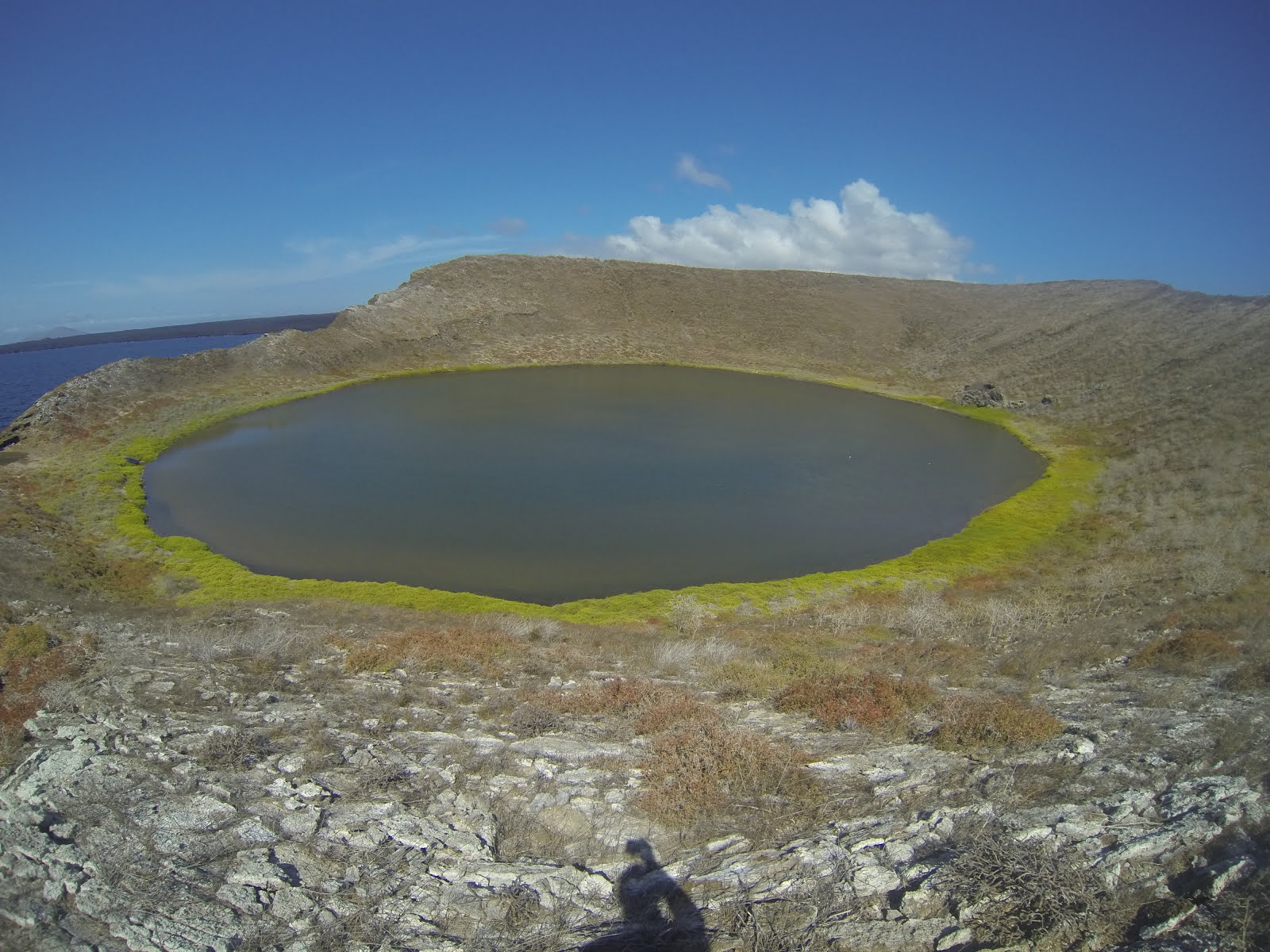
My colleagues and I have been monitoring the local climate and lake conditions of both Genovesa and Bainbridge crater lakes for the past 6 years.  These lakes are unique among the Galapagos islands, as connections to the sea have maintained vibrant lake ecosystems among a very hostile and dry volcanic landscape.  These lakes cook under the hot tropical sun and low rainfall, concentrating the lake to about 5 times that of the local seawater and creating a warm, very productive ecosystem. These local oases support a vibrant population of marine birds, including boobies, frigates and flamingos.
Great Frigate bird male at Genovesa crater lake.  Photo credit: Stephan Hlohowskyj


Red Footed Booby, Genovesa crater lake. Photo credit: Stephan Hlohowskyj
Great frigate male displays his stuff at Genovesa. Photo credit: Diane Thompson

Flamingoes at Bainbridge crater lake. Photo credit: Stephan Hlohowsky

But we are more interested in what lies beneath the surface: the sediments accumulating at the bottom of these lakes.  As the local climate changes, now and in the past, so does the type of sediments accumulating on the lake bottom.  Cores of sediment have been collected from these lakes, and these cores show a rich history of climate changes that have been captured in their layers. 

Jessica Conroy samples a sediment core in October 2012. Photo credit: Diane Thompson

Close up of a sediment core from Genovesa crater lake, showing the distinct layers of sediment.  Photo credit: Diane Thompson
But what do these layers tell us?  Because these very saline lakes are very sensitive to changes in rainfall, they have captured past El Niño events (and their dry, cold water counterparts La Niñas). 

For example, the sediment record from Bainbridge has been used to study the frequency of El Niño events over the past 6000 years.  The sediments accumulating at the bottom of this lake may therefore be key to understanding how the frequency of El Niño events has changed in the past and what may have driven these changes in El Niño frequency.  In turn, this will improve our understanding of how the frequency of these events may change in the future as our global climate continues to warm.

Despite the importance of these Galapagos lake sediment archives to our understanding of El Niño variability, there is a lot we still have to learn about these lakes to properly interpret the story told within their layers.  

To improve our ability to interpret climate story from these lakes, we have been monitoring the local climate and lake conditions while simultaneously collecting all of the sediments falling in the lake in simple sediment traps.  This allows us to better understand how changes in climate affect the physical and chemical characteristics of the lake, and how that in turn changes the type of sediments falling to the lake bottom.

Collecting the Bainbridge sediment trap samples in 2012. Productive lake.  mmmm productive!  Photo credit: Diane Thompson
We have been monitoring these lakes since December of 2009, a period that covers more than 5 full seasonal cycles and includes a weak El Niño, a moderate El Niño and sustained La Niña conditions.  However, we have yet to capture the effect of a strong El Niño on these lakes, which is key to studying El Niño events in the past.

Over the next 4 days, we will collect and redeploy our instruments at these two lakes so that we can measure the fingerprint of the 2015/2016 El Niño in Genovesa and Bainbridge crater lakes.


This material is based upon work supported by the National Science Foundation under Grant Number (NSF AGS-1561121). Any opinions, findings, and conclusions or recommendations expressed in this material are those of the author(s) and do not necessarily reflect the views of the National Science Foundation.